

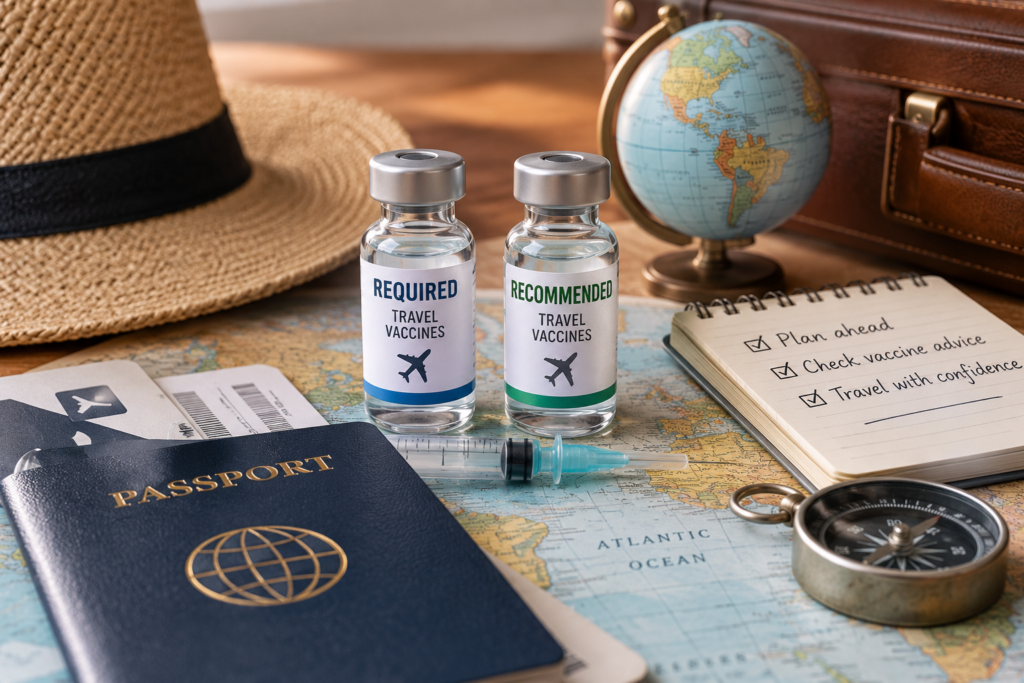
A required travel vaccine is a legal condition of entry. A government asks for an official certificate at the border, and without it, you can be refused entry, quarantined, or vaccinated on arrival. Yellow fever is the main example.
A recommended travel vaccine is never checked at passport control. It is advised because of what you are likely to be exposed to on the trip, such as hepatitis A from food and water, or rabies from an animal bite.
Required protects the country. Recommended protects you.
That sounds simple until you find that the same country can demand a certificate from one traveller and wave the next one through.
The rest of this guide covers why that happens, which vaccines are genuinely mandatory in 2026, and how to check your own trip properly.
Table of Contents
Why Some Vaccines Are Mandatory
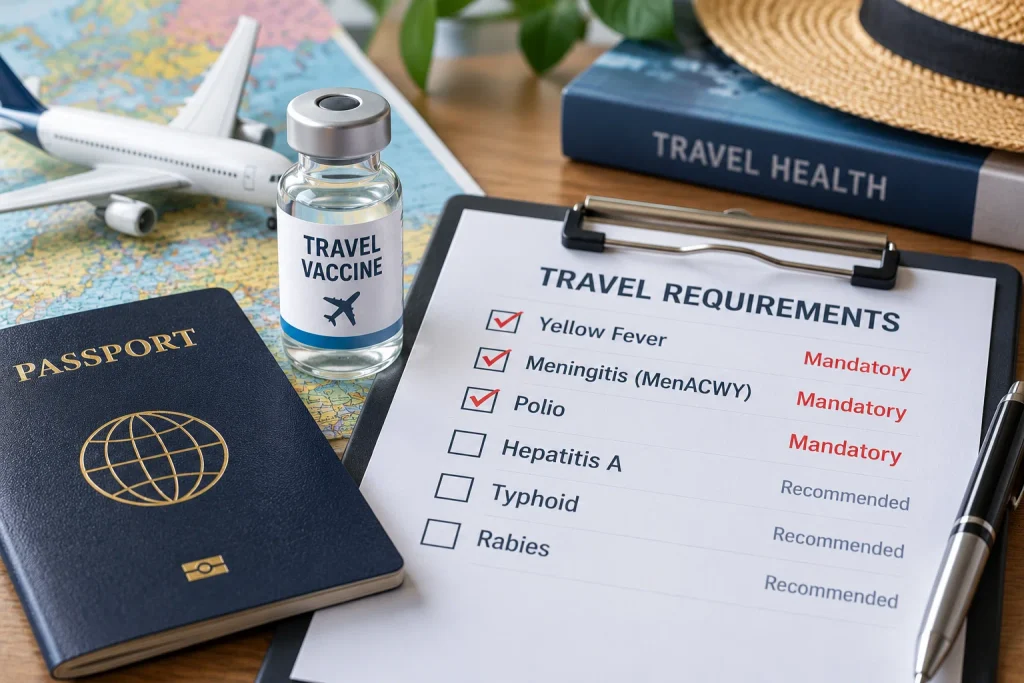
Entry requirements exist under the International Health Regulations, agreed by WHO member states. The point of them is to stop a disease from being carried across a border and taking hold somewhere new.
Yellow fever is the clearest case. The mosquito that spreads it, Aedes aegypti, lives in parts of Asia that have never had a yellow fever outbreak.
So countries like India and Thailand ask for certificates from travellers arriving from Africa or South America. They have no yellow fever. They are trying to keep it that way.
This is worth sitting with, because it explains a lot of the confusion. A required vaccine is a public health measure aimed at the border, not personal health advice aimed at you.
Required vs Recommended at a Glance
| Required | Recommended | |
| Who sets it | The destination government | Your clinician, based on your trip |
| Proof needed | Official certificate, often the ICVP | None, though a record is useful |
| Checked at | Visa stage, airline check-in, border | Nowhere |
| If you skip it | Refused entry, quarantine, forced vaccination | No legal problem, real health risk |
| Examples | Yellow fever, MenACWY for Hajj, polio for some routes | Hepatitis A, typhoid, rabies, tetanus boosters |
| Lead time | At least 10 days for yellow fever | 4 to 8 weeks for full courses |
What “Required” Actually Means
Required means a border official can stop you. In practice, the check happens earlier than that, at visa application or at the airline desk.
Airlines carry the cost of flying someone who is then refused entry, so staff do look. Being turned away at check-in in Heathrow is more common than being turned away in Accra.
If you arrive without a valid yellow fever certificate where one is needed, the country can isolate you for up to six days. That figure is not arbitrary. It matches the incubation period of the virus.
Some border posts will simply vaccinate you on the spot. You have no say over the vaccine batch, the needle, or who gives it.
Which Travel Vaccines Are Genuinely Required for Entry
The list is much shorter than most travellers assume.
Yellow fever
Roughly 20 countries, mostly in West and Central Africa, ask every arriving traveller for a certificate. Angola, Ghana, Uganda, Cameroon and the Democratic Republic of the Congo sit in that group.
Many more countries ask only if you have come from, or passed through, a risk country. South Africa, Kenya, India, Thailand and Australia all apply that rule.
MenACWY for Hajj and Umrah
Saudi Arabia will not issue a pilgrimage visa without a valid quadrivalent meningococcal certificate. The conjugate vaccine counts for five years, the older polysaccharide version for three, and the dose must be at least 10 days before arrival.
Polio
A handful of countries with ongoing poliovirus transmission ask residents and long-stay visitors to show a dose given between four weeks and 12 months before departure. Saudi Arabia applies a matching rule for arrivals from those countries.
COVID-19
Almost every country has dropped its requirement. Saudi Arabia still lists proof for pilgrims, so Hajj and Umrah travellers should confirm the current position before booking.
Everything else is advice. Hepatitis A, typhoid, hepatitis B, rabies, Japanese encephalitis, tick-borne encephalitis and cholera are not entry requirements anywhere.
The Yellow Fever Certificate Explained
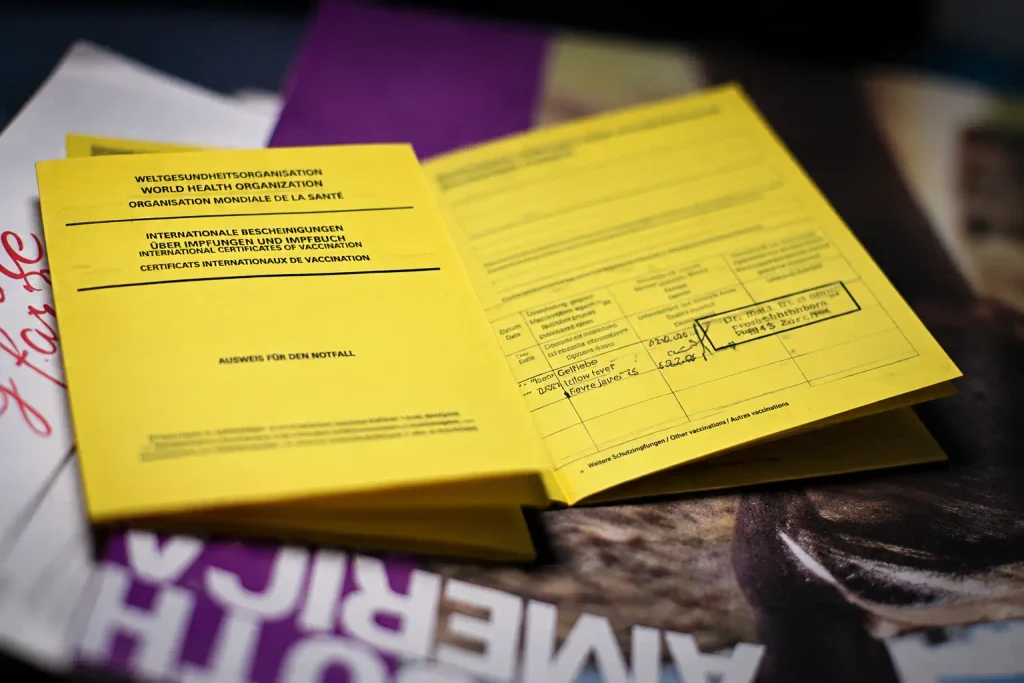
The proper name is the International Certificate of Vaccination or Prophylaxis, shortened to ICVP. Most people call it the yellow card or the yellow book.
It is a specific WHO document. A letter from your GP will not do, and neither will a screenshot of your NHS record.
Two rules matter most.
It becomes valid 10 days after your injection. Land on day nine and your certificate is not yet active, whatever the date on the vaccine.
It lasts for life. Since 11 July 2016, the ICVP has been valid for the lifetime of the person vaccinated, and that applies backwards too.
So if you dig out a yellow book from 2009 with a printed expiry of 2019, it still counts. No country can insist on a booster as a condition of entry. People pay for repeat vaccination over this every year without needing to.
One more thing from the clinic side. The certificate must not be altered, and your details have to match your passport exactly.
Travellers have been fined and detained over a missing stamp or a date written in numbers rather than with the month spelled out.
In England, Wales and Northern Ireland, only a centre designated by NaTHNaC can give the vaccine and issue the certificate. Public Health Scotland handles designation north of the border.
Chemitex Pharmacy is a registered Yellow Fever Vaccination Centre, so the vaccine and the stamped certificate are both done in one appointment.
What “Recommended” Means and Why It Isn’t Optional
Nobody will stop you from boarding without a hepatitis A vaccine. Hepatitis A is still the infection travellers actually come home with.
It spreads through contaminated food and water, which means a resort buffet counts as exposure just as much as a street stall. Two doses give protection for around 25 years.
Typhoid works the same way and matters most for South Asia, where the strains circulating are increasingly hard to treat with older antibiotics.
Rabies deserves its own paragraph. Pre-travel doses do not make you immune.
What they do is change what happens after a bite. Vaccinated travellers need two follow up doses instead of a course of immunoglobulin, which is expensive, often unavailable, and sometimes a long flight away from wherever you were bitten.
Then there are the boosters people forget. Tetanus, diphtheria and polio come as one combined jab in the UK and are due every 10 years for travel to many countries. Worth checking your date before you book, though: if you have had a booster or primary course within the last five years, you will not be given another.
Malaria tablets sit outside all of this. There is no malaria vaccine for travellers, so prevention means bite avoidance and the right tablets for the region and season.
Why the Same Country Can Give Two Travellers Different Answers
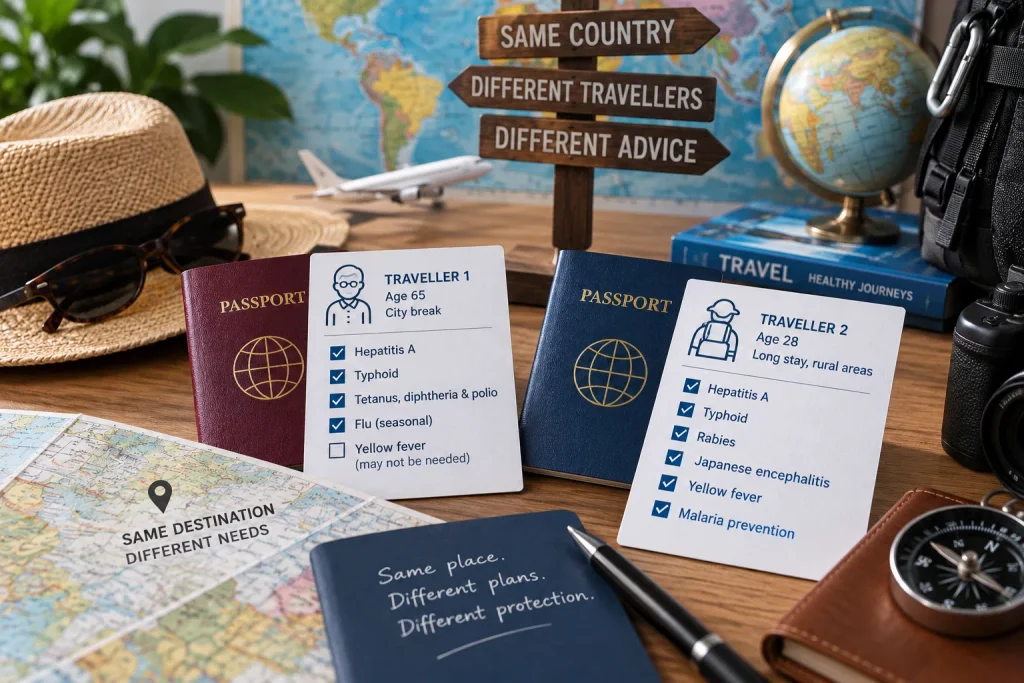
This is the part that catches people out, and it is not an error on anyone’s part.
Your route, not just your destination. A layover of more than 12 hours in an airport in a yellow fever country can trigger a certificate requirement at your final stop. London to Johannesburg via Nairobi is a different trip, on paper, from London to Johannesburg direct.
Your age. Some countries set the threshold at nine months, others at one year. A family of four can need three certificates and no fourth.
How long you are staying. Polio rules often apply only to residents and visitors staying four weeks or more.
Where you are going inside the country. Yellow fever advice for Brazil depends on the state. Rabies advice depends on whether you are in Rio or cycling through rural Minas Gerais.
What you are doing. Backpacking, volunteering in a clinic, working with animals, or visiting family and staying in their home all raise exposure compared with a hotel stay.
When you travel. Meningitis risk across the African belt climbs during the dry season, roughly December to June.
Your own health. Pregnancy, immune suppression, egg allergy and age over 60 all affect whether a live vaccine like yellow fever is safe for you. In some cases, a Medical Exemption Certificate can be issued on the ICVP if the vaccine is medically contraindicated, though border acceptance remains at the discretion of the destination country.
How to Check the Requirements for Your Trip
Start with TravelHealthPro, run by NaTHNaC. The country pages separate requirements from recommendations clearly, which most travel blogs do not.
Cross-check the FCDO entry requirements page on gov.uk for the same country, and the destination’s own embassy if the two disagree.
Check your full itinerary. Every country you land in counts, including the one where you only change planes.
Then book a consultation. A pharmacist can only give you a straight answer once they know your route, your dates, your age, your medical history and what you will be doing there.
Six to eight weeks ahead is the sensible point to do this. Some courses need three doses over a month, and yellow fever needs 10 clear days before you land.
Short notice is still worth a conversation. There is almost always something useful to do, even a week out.
Worth one last look a fortnight before you fly. Outbreak-driven rules do change, and Panama and Brazil have both had their yellow fever listings updated in recent years.
Book a Travel Health Consultation

Chemitex Pharmacy on Hornsey Road is a registered Yellow Fever Vaccination Centre serving Islington, Holloway and Finsbury Park.
Your appointment covers a full risk assessment against your itinerary, the vaccines you need, antimalarial tablets where relevant, and your ICVP issued and stamped on the day.
Book online or call the pharmacy. If you are travelling in the next fortnight, mention it when you book so we can prioritise the appointment.
FAQs
Do I need any vaccines to enter the UK?
No. The UK sets no vaccination requirements for entry, including for returning residents arriving from yellow fever countries.
Can an airline refuse to board me over a missing certificate?
Yes. Carriers face fines for transporting passengers who are then refused entry, so check-in staff verify certificates before departure.
What if I lose my yellow fever certificate?
The centre that vaccinated you can usually issue a duplicate from its records. Photocopies and phone photos are not accepted at borders.
Do cruise passengers face different rules?
Each port call counts as an entry, so requirements stack across the itinerary. Cruise lines typically verify certificates before you embark.
Are travel vaccines free on the NHS?
Some are, including combined tetanus, diphtheria and polio, typhoid, hepatitis A, and cholera at GP practices. Yellow fever is always private.
Conclusion
Required and recommended sound like strong advice and weak advice. They are two different systems.
Required vaccines are for a border official and require paperwork. Yellow fever is the one that catches most UK travellers, with MenACWY for Hajj and Umrah and polio for a small set of routes.
Recommended vaccines depend on your actual risk of getting ill, and skipping them carries no legal penalty and a real cost.
Your route, your age, your length of stay, and your health all shift the answer, which is why a generic country list is a starting point rather than a plan.Check TravelHealthPro, then get the details confirmed by a travel health clinic with enough time left to act on it.

Dipesh Jogi is the Superintendent Pharmacist at Chemitex Pharmacy in Islington, London. A GPhC-registered pharmacist (GPhC 2073384), he provides professional pharmacy care and supports patients through NHS prescriptions, vaccinations, health checks, and private clinical services.