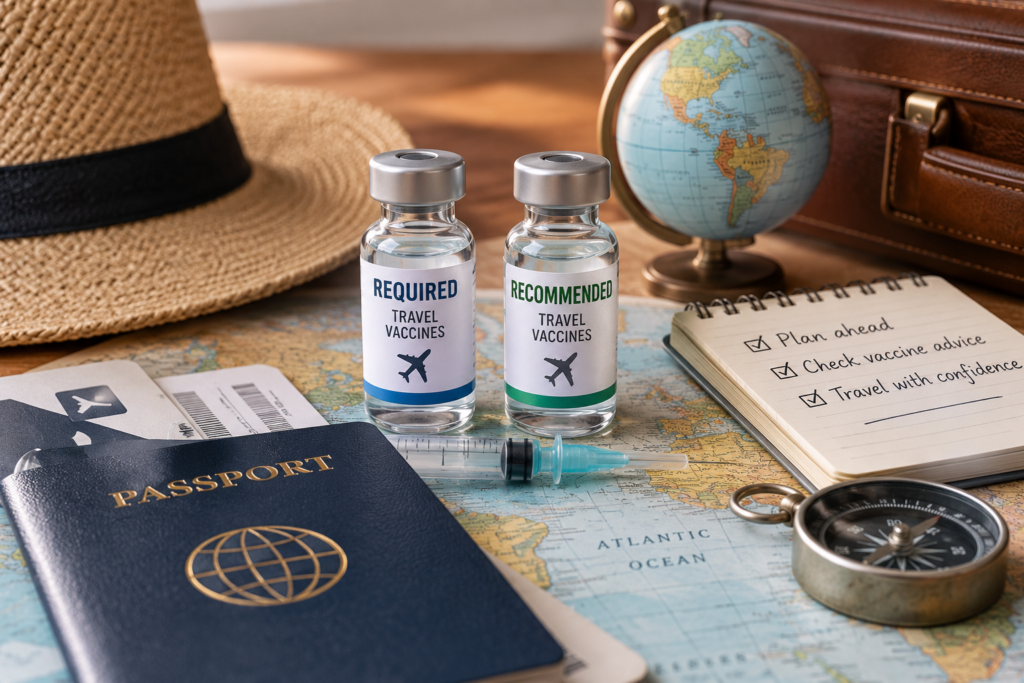


Yes, older travellers can have travel vaccines, and most of them are just as safe after 60 as they were at 30.
Hepatitis A, typhoid, rabies, Japanese encephalitis, tick-borne encephalitis and MenACWY are all inactivated. Age alone is not a reason to skip any of them.
Yellow fever is the one exception. It is a live vaccine, and the risk of a serious reaction rises after 60, so a first-ever dose needs a proper risk assessment rather than a routine booking.
The bigger issue for most people over 60 is not the jab itself. It is the tablets you already take, the conditions you already have, and how long your immune system needs to respond.
Here is how a Travel Clinic works through all of that before you fly.
Table of Contents
Why Age Changes the Travel Health Picture

Your immune system gets slower with age, not absent. Antibody responses to vaccines tend to be lower and take a little longer to build, which is why timing matters more after 60 than it did in your twenties.
Hepatitis B is the clearest example. Response rates drop steadily with age, so an older traveller may need blood testing afterwards or an extra dose to get there.
The second change is medical baggage. By 65, most patients I, Dipesh Jogi (superintendent pharmacist and independent prescriber, GPhC 2073384), see are on at least one repeat prescription, and several are on three or more.
Those medicines interact with malaria tablets far more often than they interact with vaccines.
The third is consequence. A bout of travellers’ diarrhoea that flattens a 25-year-old for two days can tip someone on diuretics or an ACE inhibitor into acute kidney trouble.
So the question is rarely “is this vaccine safe for me”. It is “what happens to me if I catch the thing it prevents”.
Which Travel Vaccines Are Recommended for Older Travellers
Destination drives the list, not your birth year. That said, a few come up again and again in the over-60 age group.
| Vaccine | Why it matters after 60 | Type |
| Hepatitis A | Illness runs longer and harder with age, with a higher chance of hospital admission | Inactivated |
| Typhoid | Common on trips to South Asia, including visiting family | Inactivated |
| Rabies | Post exposure treatment is hard to get in remote areas, and pre travel doses simplify it | Inactivated |
| Tetanus, diphtheria and polio | Many adults last had a booster decades ago | Inactivated |
| Japanese encephalitis | Rural Asia, longer stays, and worse outcomes in older adults | Inactivated |
| Tick borne encephalitis | Forested parts of central and eastern Europe, walking holidays | Inactivated |
| MenACWY | Required for Hajj and Umrah, useful for parts of sub Saharan Africa | Inactivated |
| Cholera (oral) | Occasionally advised for aid work or outbreak areas | Inactivated |
Rabies deserves a mention on its own. The full UK pre-exposure course consists of three doses on days 0, 7, and 21 to 28, though a two-dose schedule on days 0 and 7 suffices for short trips. Pre-travel doses do not make you immune, but they cut the post-bite treatment down and remove the need for rabies immunoglobulin, which is scarce in most of the countries where you would need it.
If you are cycling through Vietnam or staying near village dogs in India, it is worth the three appointments.
Yellow Fever and Travellers Over 60

Can over 60s have the yellow fever vaccine? Yes, but not automatically.
Yellow fever vaccine contains a weakened live virus. Two rare reactions, vaccine-associated neurotropic disease (YEL-AND) and vaccine-associated viscerotropic disease (YEL-AVD) which occurs at roughly 0.3 per 100,000 doses overall and rises to about 1.2 per 100,000 in people aged 60 and over, occur more often in people receiving their first ever dose after 60. Under PGD and prescriber criteria, a first dose after 60 requires a strict clinical risk assessment balancing exposure against severe adverse risks.
The numbers are still small. They are high enough that UK guidance asks for a documented risk assessment weighing the real chance of exposure against the vaccine risk.
That assessment is not paperwork for its own sake. A two week Kenyan safari in an area with no recent transmission is a different conversation from a month on the Amazon in wet season.
Certificate rules matter here too. Under the International Health Regulations, a yellow fever certificate is now valid for life, so a single dose from 1998 usually still counts for entry.
If you have proof of a previous dose, you may not need another one at all. Dig out the old yellow booklet before you book.
Where the vaccine is not suitable, a registered centre can issue a signed exemption letter for border control. Entry is at the discretion of the destination country, so this needs discussing early rather than at the airport.
Chemitex Pharmacy (332 Hornsey Road, London N7 7HE, 0207 272 4869) is a registered Yellow Fever Vaccination Centre, so the assessment, the vaccine and the certificate all happen in one appointment on Hornsey Road.
Live Vaccines, Long-Term Conditions and Medication
Only a handful of travel vaccines are live. Yellow fever, oral typhoid capsules and the extra MMR dose some travellers need are the ones that come up.
These are the vaccines affected by immune suppression. Everything else on the list is inactivated and cannot cause the illness it protects against.
Bring your repeat prescription list to the appointment. The medicines that change the plan include:
Steroids taken at higher doses for two weeks or more, such as prednisolone at 20mg daily or above.
Disease modifying drugs for rheumatoid arthritis, psoriasis or inflammatory bowel disease, including methotrexate, azathioprine and the biologic injections.
Chemotherapy, or treatment finished within the last six months.
A history of thymus gland problems, thymus removal or thymoma, which rules out yellow fever vaccine permanently.
Stable diabetes, blood pressure, asthma, heart disease and osteoarthritis are not barriers to any travel vaccine. Neither is being on a blood thinner, although the injection technique changes slightly.
A well controlled long-term condition is a reason to plan, not a reason to be turned away.
Routine NHS Vaccines to Check Before You Travel

This is the part most people skip, and often the part with the most benefit.
Flu and COVID protection matter more abroad, not less. Crowded flights, coaches and cruise ships spread respiratory infection efficiently, and the southern hemisphere flu season runs opposite to ours.
Shingles vaccination is offered on the NHS from 65, with an ongoing programme for those aged 70 to 79. Long flights, disrupted sleep and heat are a well known trigger for a flare.
The pneumococcal jab is a one off dose at 65 for most people. Pneumonia after a chest infection abroad is a genuine risk, and you want that one already done.
RSV vaccination is offered from 75. If you have had your letter and not booked, do it before a trip rather than after.
Tetanus, diphtheria and polio (Revaxis) is the one I check most often. A Revaxis booster is recommended every 10 years for travel to areas with limited medical care or high risk, provided the primary course of 5 lifetime doses has been completed.
Adults in the UK usually have five lifetime doses. Many people born before the 1960s do not, so check your GP record.
Malaria Tablets and Existing Medicines
Malaria is where the real prescribing care sits for older travellers. There is no vaccine in routine UK use, so tablets and bite avoidance do the work.
Which tablet suits you depends on your kidneys, your heart rhythm and your current medicines.
Atovaquone with proguanil, sold as Malarone, is generally well tolerated. It is contraindicated and cannot be used if your creatinine clearance is below 30 ml/min (severe renal impairment).
Doxycycline is cheap and effective. It increases the effect of warfarin, causes sun sensitivity that matters more on thinner skin, and needs a full glass of water sitting upright to avoid irritating the gullet.
Mefloquine is taken once weekly. It is strictly excluded and cannot be given to anyone with current or past depression, anxiety, psychosis, other psychiatric conditions, or a history of seizures/epilepsy, and requires careful evaluation alongside beta blockers.
Chloroquine with proguanil is rarely first choice now and is avoided in epilepsy and in some eye conditions.
Bring the actual list, not a summary from memory. Half the prescribing decisions I make in a travel consultation come from that list rather than from the destination.
Beyond Vaccines: Practical Health Planning

Vaccines are one page of the plan. The rest of it tends to matter just as much.
Clots on long haul flights are the most common avoidable problem. Move every couple of hours, drink water, and ask about compression stockings if you have had a clot, recent surgery or reduced mobility.
Heat is the second. Diuretics, beta blockers and some antidepressants all blunt your ability to cope with high temperatures, and dehydration creeps up quietly.
Carry your medicines in hand luggage, in original boxes, with a printed repeat list. Split them across two bags if you are travelling as a couple.
Some countries restrict codeine, strong painkillers and certain sleeping tablets. Check the embassy rules before you pack them.
Travel insurance is the one people get wrong. Declare every condition and every medicine, including the ones you think are trivial, or a claim can be refused outright.
A GHIC card covers state healthcare in the EU at the same cost as a local resident. It is not insurance, it does not cover repatriation, and it will not fly you home.
When to Book and What to Bring
Aim for six to eight weeks before departure. The full rabies pre-exposure course needs three appointments over 21 to 28 days (or two doses on days 0 and 7 for short trips), hepatitis B may need a course plus a blood test, and yellow fever certificates only become valid ten days after the injection.
Last minute travel is still worth a consultation. Even a week out, several vaccines give useful protection and malaria tablets can be started in time.
Bring four things to the appointment:
Your full repeat prescription list, including anything bought over the counter.
Any old vaccination records, especially a yellow fever certificate or a vaccine card from previous travel.
Your detailed itinerary with dates, regions and accommodation type, since rural and urban risk differ inside the same country.
Details of any planned activities, such as trekking at altitude, diving, volunteering in healthcare or visiting family in rural areas.
Book Your Travel Health Consultation

Chemitex Pharmacy runs a private travel clinic on Hornsey Road, serving Islington, Holloway, Finsbury Park and the surrounding areas of North London.
As a registered Yellow Fever Vaccination Centre with an independent prescriber on site, we can complete the risk assessment, give the vaccine and issue the certificate in the same visit.
Appointments can be booked online or by calling the pharmacy. Bring your medicines list, and we will build the plan around it.
Frequently Asked Questions
Can I have a travel vaccine if I take warfarin or a DOAC?
Yes. The injection is given with a fine needle and firm pressure afterwards. Tell the pharmacist beforehand, and have your INR within range if applicable.
Are travel vaccines free on the NHS for over 60s?
Some are. Your GP may provide hepatitis A, typhoid, cholera and combined tetanus, diphtheria and polio free. Yellow fever, rabies and Japanese encephalitis are private.
Do I still need travel vaccines for a cruise?
Yes. Port stops count as visits to each country, and shared dining and ventilation on ships raise the risk of respiratory and stomach infections.
Can I have travel jabs at the same appointment as my flu vaccine?
Usually yes. Inactivated vaccines can be given on the same day in different arms, with no waiting period between them and no reduced protection.
Will a vaccine still work if I am on immunosuppressant medication?
It may work less well. Inactivated vaccines remain safe, though protection can be weaker, so extra doses or antibody testing are sometimes advised.
Key Takeaways
Age on its own rarely rules out a travel vaccine. Nearly everything on the standard list is inactivated and safe after 60.Yellow fever is the real exception, needing a proper risk assessment before a first dose, and an old certificate may still cover you for life.
Your medicines matter more than your age. They shape the malaria tablet choice and decide whether a live vaccine is suitable.Routine NHS jabs, including shingles, pneumococcal, flu and RSV, are worth checking at the same time.
Book six to eight weeks ahead, bring your repeat list and your old vaccine records, and let the pharmacist build the plan around both.